Duyet Thi Duong Hue: Vietnam's Oldest Royal Theater Preserving Golden Traces of the Past

Central

Thua Thien Hue

Hue Imperial Citadel

Sovaba.travel

Updated at: 13/10/2026

1. Where is Duyet Thi Duong in Hue?

Duyet Thi Duong is situated inside the Purple Forbidden City within the Hue Imperial Citadel, a prominent monument in the Complex of Hue Monuments inscribed as a UNESCO World Cultural Heritage site in 1993. Nestled within the ancient royal grounds, the theater was intimately linked to the artistic life of the Nguyen Dynasty, serving as the premier venue for classical court opera performances staged for the emperor and royal family.

  • Address: Hue Imperial Citadel Area, Hue City.

  • How to get there: From Ngo Mon Gate, visitors can walk into the Purple Forbidden City and find their way to Duyet Thi Duong by following the Hue Imperial Citadel visitor map.

Duyet Thi Duong is integrated into the overarching royal architectural complex, complete with courtyards, gardens, and facilities serving royal daily life. Historical records indicate that the surrounding area once housed facilities dedicated to royal medicine and cuisine, reflecting the remarkably comprehensive organization of court life under the Nguyen Dynasty.

Exterior of Duyet Thi Duong Theater

Photo: Exterior of Duyet Thi Duong Theater

2. Over 200 Years of History and Architecture

Commissioned by Emperor Minh Mang in 1826, Duyet Thi Duong stands as one of the hallmark royal theaters of the Nguyen Dynasty, closely tied to the artistic and cultural life of the court. Spanning over two centuries through numerous historical upheavals, the structure still retains its distinctive architectural characteristics, reflecting the sophistication with which the royal court organized performance and appreciation spaces.

Architecturally, Duyet Thi Duong is renowned for its traditional timber framework, Hue court-style multi-tiered roof, and a centrally placed stage. Seating was arranged in strict hierarchical order, clearly mirroring the ceremonial protocols of the imperial court. Designated areas for the emperor, court mandarins, distinguished guests, and attendants were distinctly partitioned, showing that performing arts during the Nguyen period were not merely entertainment, but intimately tied to royal rites and court decorum. In the palace of old, where every step conformed to ritual and every celebration carried imperial prestige, Duyet Thi Duong served as a sanctum dedicated to art. Built under Emperor Minh Mang in 1826, the theater bore witness to the glorious zenith of the Nguyen court stage, where rhythmic drumbeats, singing, and choreography harmonized within the dignified atmosphere of the imperial capital. Over two centuries later, Duyet Thi Duong still captures in its architectural posture the hallmarks of an era whose court culture achieved rare elegance and discipline.

The edifice exhibits the quintessential beauty of Hue's traditional wooden architecture, with roofing, timber joinery, and spatial layout bearing an indelible royal signature. The central stage served as the focal point for music, dance, and court opera. Viewing positions were structured hierarchically, reflecting the rigorous ceremonial etiquette of the Nguyen court. Here, art was never merely for amusement; it was an integral part of imperial cultural life, entwined with seasonal celebrations, aesthetic ideals, and royal decorum.

Entrance gate to Duyet Thi Duong

Photo: Entrance gate to Duyet Thi Duong

Having hosted royal performance evenings for the emperor and royal family, Duyet Thi Duong was where classical opera plays came alive through voice, string music, drum rhythms, and highly stylized movements rich in symbolism. Each act unveiled an artistic realm distilled from history, literature, and traditional moral philosophy. In this sacred space, performers performed not only with consummate skill but also within rigorous artistic standards, ensuring every lyric and gesture remained in perfect harmony with the court aesthetic.

Time and the ravages of history caused damage to Duyet Thi Duong on multiple occasions, yet the building's value has never rested solely in its surviving timber beams or architectural lines. It remains the living memory of an art form that once flourished in royal life, a vital bridge connecting Hue's tangible monuments with its intangible cultural heritage. Today, entering Duyet Thi Duong allows visitors to draw closer to the world of the Nguyen court, listen to the echoes of traditional art, and feel the cultural depth that endures in the heart of the Ancient Capital.

3. Duyet Thi Duong and Hue Royal Court Music

Hue Royal Court Music (Nha Nhac) is a genre of music closely associated with court ceremonies and cultural events of the Nguyen Dynasty, performed alongside court dances within a highly structured, solemn, and aesthetic system. Every melody and rhythmic beat followed strict formulas, reflecting the imperial philosophy of ritual and art. In 2003, UNESCO proclaimed Hue Royal Court Music as a Masterpiece of the Oral and Intangible Heritage of Humanity; in 2008, it was inscribed on the Representative List of the Intangible Cultural Heritage of Humanity.

At Duyet Thi Duong, the Hue Royal Traditional Theater of Art has dedicated extensive efforts to collecting, preserving, and restaging traditional court art forms, including:

  • Hue Royal Court Music: Numerous repertoire pieces belonging to major ceremonial ensembles (dai nhac) and chamber ensembles (tieu nhac) have been preserved and revived, such as Tam luan cuu chuyen, Phu luc dich, and Kim tien.

  • Royal Court Dance: Ancient dances such as Luc cung hoa dang (Offering of the Six Incense Lanterns Dance), Vu phien (Fan Dance), and Lan mau xuat lan nhi (Mother Unicorn Giving Birth to Her Cub) showcase the graceful, dignified beauty of palace performances.

  • Royal Court Opera: Classic excerpts such as Ky Lan Anh, On Dinh chem Ta, and Phan Le Ba bring historical and literary tales to the stage through stylized gestures, distinctive costumes, and theatrical makeup.

With its performance space steeped in imperial history, Duyet Thi Duong offers visitors the privilege of experiencing traditional performing arts right in the heart of the Hue Imperial Citadel. Through the sounds of music, graceful dances, and classic opera excerpts, the grandeur and refinement of court art vividly unfold, allowing audiences to appreciate the difference between art forms once reserved for royal ceremonies and the folk performances rooted in community life.

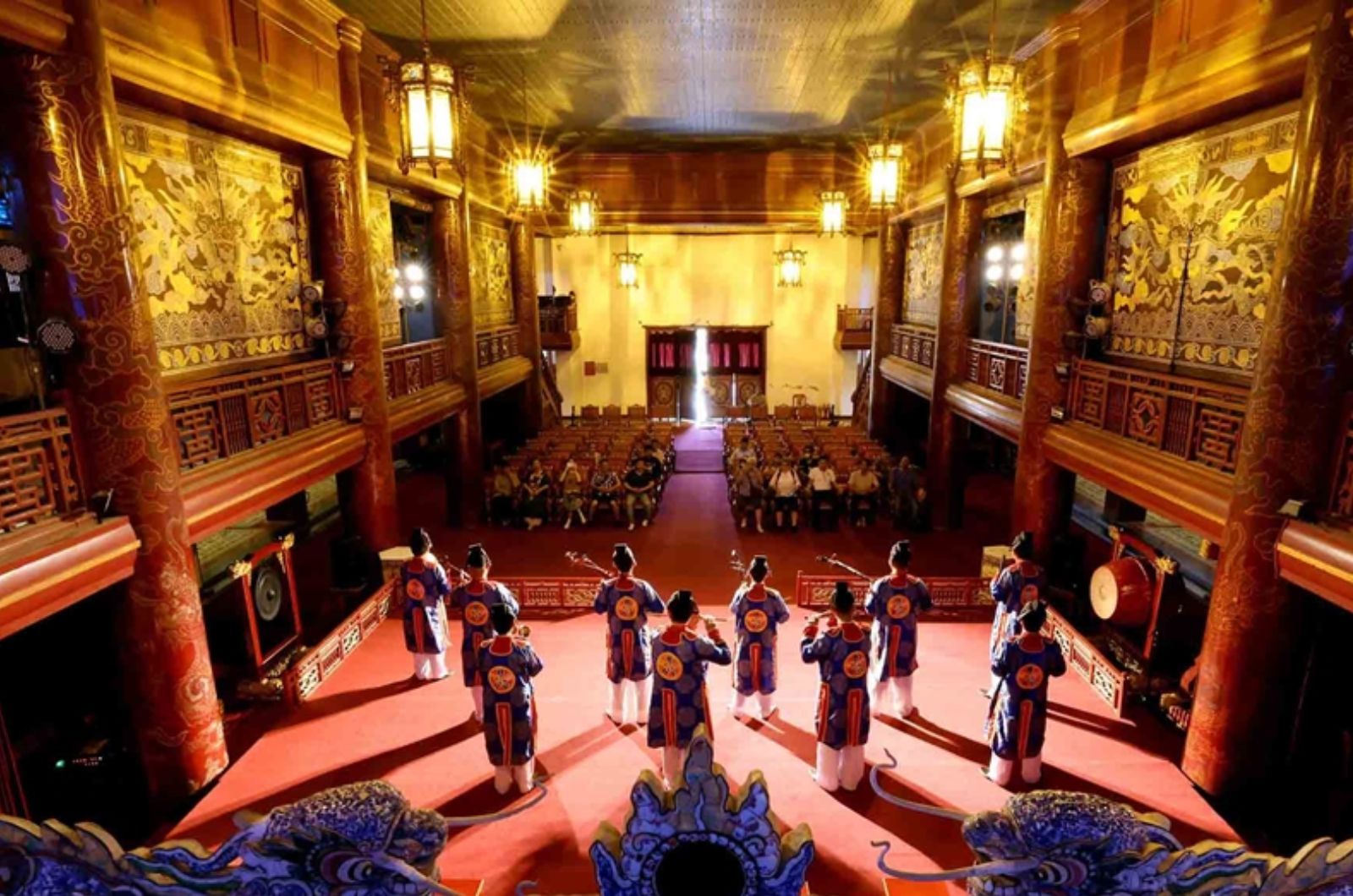
Hue Royal Court Music performances at Duyet Thi Duong

Photo: Hue Royal Court Music performances at Duyet Thi Duong

4. Experiencing Royal Court Art Performances at Duyet Thi Duong

Visiting Duyet Thi Duong gives visitors the opportunity to enjoy royal court art inside the historic theater that once served the Nguyen Dynasty emperors. A typical performance program weaves together Nha Nhac court music, royal court dance, and classical opera excerpts, bringing audiences closer to the refined cultural world of the imperial palace. The resonant sound of ceremonial praise drums, the trill of bamboo flutes, and the harmonious melodies of the 16-string zither, gongs, and other traditional instruments create layers of sound that are both solemn and deeply expressive.

Reference Performance Schedule (subject to change based on seasons and actual programming):

  • Morning: 10:00 – 10:35

  • Afternoon: 15:00 – 15:35

In addition to regular performance schedules, Duyet Thi Duong and Hue court performing arts troupes may participate in thematic programs, cultural exchanges, or special celebrations. Selected programs, such as the Royal Palace Banquet, pair artistic performances with imperial cuisine, offering a multisensory discovery of Nguyen Dynasty culture. Because performance schedules and show programs can vary, visitors are advised to check with monument management prior to their visit to plan their itinerary accordingly.

5. Latest Ticket Prices for Duyet Thi Duong Hue

To visit Duyet Thi Duong, visitors must purchase an entrance ticket to the Hue Imperial Citadel. This ticket grants access to explore the architectural grounds of the theater within the monument complex; if you wish to enjoy performances of Nha Nhac, court dance, and opera, a separate performance ticket is required.

Reference Ticket Prices:

  • Hue Imperial Citadel Entrance Ticket:

    • Adults: 200.000 VNĐ/ticket.

    • Children aged 7–12: 40.000 VNĐ/ticket.

    • Children under 7: Free admission under current policy.

  • Royal Court Performance Ticket: The quoted price is 300.000 VNĐ/ticket/show, effective from January 1, 2025. Visitors should verify details with the organizing body prior to purchase.

Opening Hours for Hue Imperial Citadel generally run from approximately 06:30–07:00 to 17:00–17:30, depending on the season and operating schedule.

Ticket prices and opening hours are subject to adjustment in accordance with applicable regulations. To ensure smooth travel plans, visitors should check the latest updates directly from the Hue Monuments Conservation Centre or at the ticket counter ahead of their visit.

A performance typically lasts around 35 minutes

Photo: A performance typically lasts around 35 minutes 

If Duyet Thi Duong is a "living museum of court art and culture," the experiences offered here breathe soul into every artifact and historical narrative. From the soaring notes of Nha Nhac and the intricate beauty of the architecture to memorable keepsakes captured on camera, each moment allows visitors not only to "see" but to truly "feel" the majesty and splendor of a bygone dynasty. Duyet Thi Duong stands as an enchanting crossroads between past and present, where Hue's royal court arts continue to radiate enduring vitality.

Loading......

Featured destinations