Thien Mu Pagoda Hue: Unique Architecture and Lesser-Known Stories
Central
Thua Thien Hue
Thien Mu Pagoda
Sovaba.travel
Updated at: 28/08/2026
1. Introduction to Thien Mu Pagoda in Hue
Thien Mu Pagoda was founded in 1601 during the reign of Lord Nguyen Hoang (Chua Tien), becoming the oldest pagoda and one of the most important national pagodas in Dang Trong (Inner Realm). With more than 400 years of history, the pagoda is not only a symbol of Hue Buddhism but also a witness to many stages of development of the Ancient Capital.
Located on Ha Khe Hill, on the banks of the poetic Perfume River, about 5 km from Hue city center, Thien Mu Pagoda enjoys a prime location with picturesque natural scenery. Thanks to its ancient beauty and special historical value, it is dubbed the "First Ancient Pagoda" of Hue. Under the reign of King Thieu Tri, the pagoda was listed among the 20 typical scenic spots of the Hue Citadel and served as inspiration for the King to compose the famous poem "Thien Mu Chung Thanh".
Having undergone numerous restorations under the Nguyen Lords and Kings Minh Mang, Thieu Tri, and Thanh Thai, Thien Mu Pagoda still preserves almost intact its ancient architectural style and sacred space. Today, the pagoda is not only an important pilgrimage site for Buddhists but also a tourism symbol of Hue, attracting numerous domestic and international tourists to visit, worship, and explore its outstanding cultural and historical values.
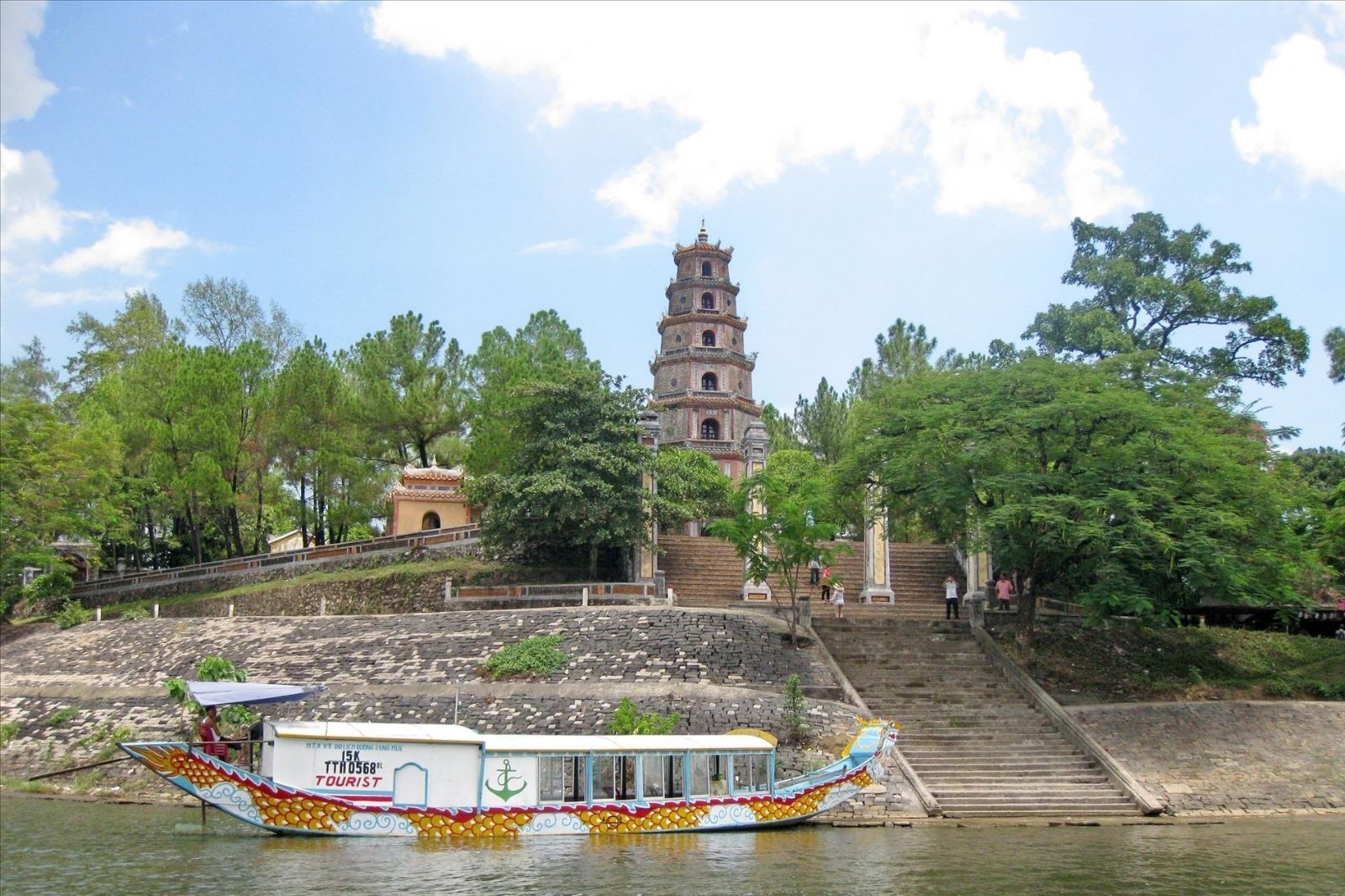
Photo: Thien Mu Pagoda located beside the Perfume River
2. Location of Thien Mu Pagoda by the Perfume River
Thien Mu Pagoda is situated on Ha Khe Hill, on the left bank of the Perfume River, possessing a feng shui location considered among the finest in Hue. According to popular belief, the hill resembles a turning dragon's head, symbolizing an auspicious dragon vein that contributes to the sacredness and majesty of the over 400-year-old ancient pagoda. Looking up from the Perfume River, Phuoc Duyen Tower stands out against the sky and green trees, creating a poetic landscape that has become a symbol of the Ancient Capital of Hue. Whenever the Dai Hong Chung bell reverberates, the sound spreads throughout the space, blending with the beauty of the river and leaving a deep impression on locals and visitors alike.
Visitors can reach Thien Mu Pagoda by road via Nguyen Phuc Nguyen Street or opt for a cruise on the Perfume River. A dragon boat trip not only offers a relaxing experience but also allows you to admire the charming beauty of both riverbanks before stepping foot into the most famous ancient pagoda in Hue.
Photo: Two Guardian statues at the Tam Quan Gate
3. Architecture of Thien Mu Pagoda in Hue through the dynasties
Spanning over 400 years of history, Thien Mu Pagoda has been restored and expanded by generations of Nguyen Lords and Kings, creating an imposing architectural complex deeply imbued with Buddhism and Hue royal court art.
During Lord Nguyen Hoang's era (1601): The pagoda was built quite simply on the grounds of an old Cham temple.
During Lord Nguyen Phuc Chu's era (1691–1725): This was the major expansion period. In 1710, the Lord ordered the casting of the Dai Hong Chung bell. In 1714, the pagoda underwent major restoration with a large-scale complex: Thien Vuong Hall, Dai Hung Hall, preaching hall, sutra storage tower, monks' quarters, meditation room... The Lord also erected a large stone stele (2.6 m high) placed on the back of a stone turtle to record the construction work and the fetching of over 1,000 sets of Buddhist sutras from China.
During the Nguyen Dynasty Kings' era: King Minh Mang continued restorations. In 1844, King Thieu Tri built Phuoc Duyen Tower and Huong Nguyen Pavilion on the occasion of his grandmother's birthday. A violent storm in 1904 caused severe damage; King Thanh Thai rebuilt it in 1907 but on a smaller scale than before.
The overall architecture follows a longitudinal axis (a "Cong" shape or linear layout), harmoniously combining wooden, brick, and stone structures with the natural landscape. Curved roof systems, wooden pillars, and lotus, dragon, and phoenix motifs bear the distinct imprint of Hue royal court art.
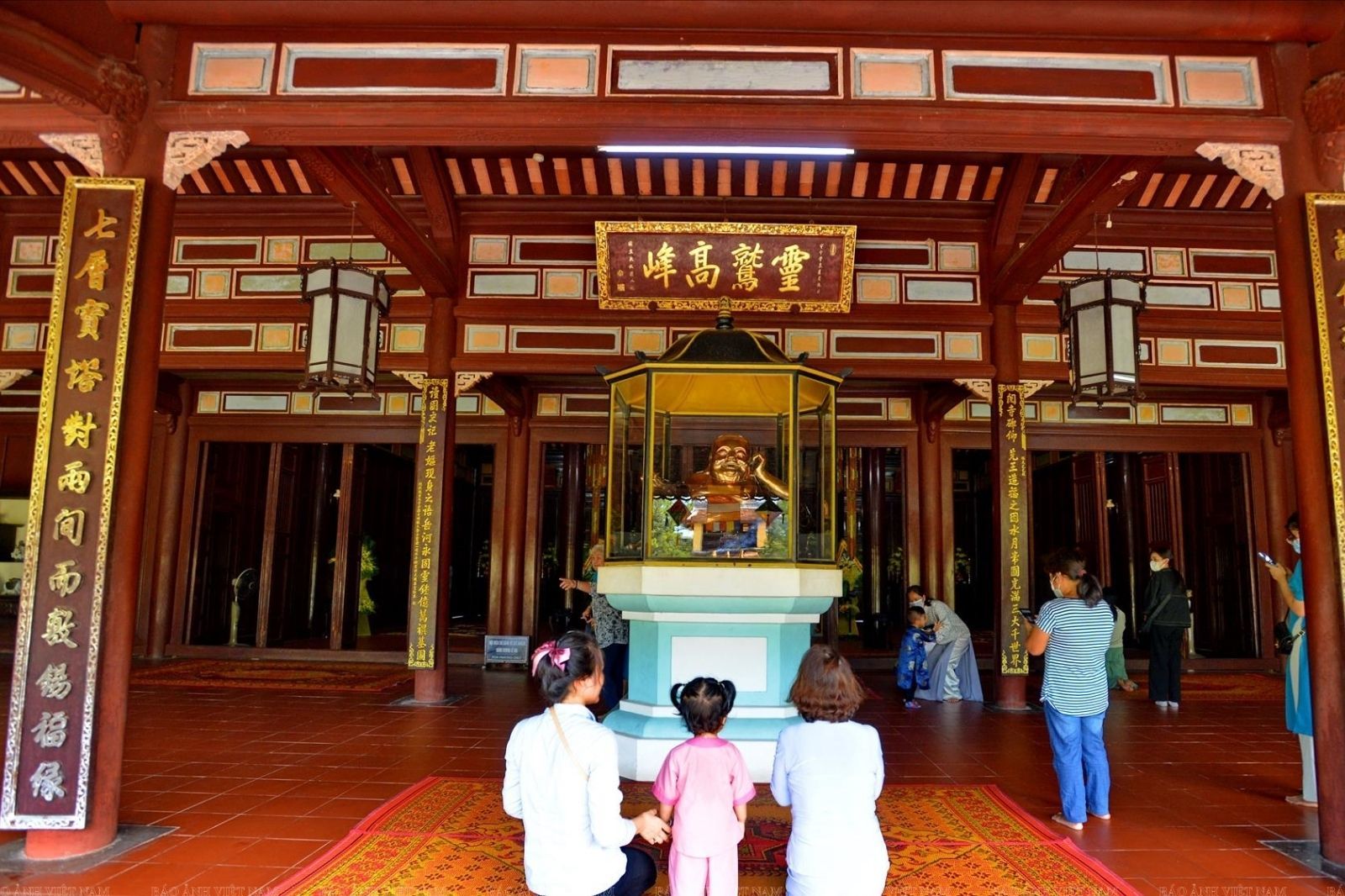
Photo: Main hall of Thien Mu Pagoda
4. Phuoc Duyen Tower – The iconic architectural symbol of Thien Mu Pagoda
Phuoc Duyen Tower is the most prominent symbol of Thien Mu Pagoda in Hue, built in 1844 under King Thieu Tri. The tower is 21m high, octagonal in shape with 7 stories, each dedicated to a manifestation of Buddha. Inside is a spiral staircase leading to the top floor, which houses a pure gold Buddha statue. In front of the tower is Huong Nguyen Pavilion with a Dharmachakra (Wheel of the Dharma) on its roof, spinning with the wind to symbolize the ceaseless operation of the Buddhist law.
On both sides of the tower are quadrangular pavilions housing stone steles inscribed with texts from the Thieu Tri era, and further back are two hexagonal pavilions containing steles and bells from the Nguyen Lords' era. The tower is not only an architectural masterpiece but also carries the meaning of praying for blessings, originally named Tu Nhan (later changed to Phuoc Duyen). Few people know that the tower was built to pray for blessings for King Thieu Tri's grandmother, and it once served as a place to store Buddhist treasures. Visitors should view the tower against the backdrop of the Perfume River, while maintaining cleanliness and respecting the sacred space.
Photo: Phuoc Duyen Tower at Thien Mu Pagoda
5. Prominent architectural works within the grounds of Thien Mu Pagoda
The grounds of Thien Mu Pagoda in Hue are spacious with many prominent structures, creating a harmonious complex. The Tam Quan gate with four towering pillars leads into the pagoda, followed by a 24-step stone staircase representing the spiritual path. Dai Hung Hall is the center, worshiping the Buddha of the Three Times, with intricately carved horizontal lacquered boards and couplets. Alongside are Dia Tang Hall and Quan Am Hall, housing statues of the Guardians and the Ten Kings of Hell.
The Dai Hong Chung bell weighs over 2 tons and was cast in 1710, representing a precious antiquity whose sound reverberates far and wide. The Sutra Storage Pavilion contains ancient Buddhist scriptures from China. In the garden, there is a miniature rockery gifted by Dao Tan (the founding father of Tuong opera), and notably the Austin car of Most Venerable Thich Quang Duc – who self-immolated in 1963 to protest Buddhist persecution, a tragic story whose details are known to few. The stupa tomb of Most Venerable Thich Don Hau (an abbot who dedicated much to the pagoda) is also located here, holding modern historical value.
6. Sacred stories and lesser-known legends of Thien Mu Pagoda
Thien Mu Pagoda is not only famous for its ancient architecture beside the Perfume River but is also associated with many sacred legends and lesser-known anecdotes, making this place even more mystical.
The Legend of the Lady in Red
First is the legend of the old lady in a red coat and green trousers – the origin of the name Thien Mu (Heavenly Lady). According to folklore and ancient texts, an old lady often appeared on Ha Khe Hill, prophesying that a "true lord" would come to build a pagoda to gather spiritual energy and strengthen the dragon vein for Nam country. Upon hearing this, Lord Nguyen Hoang ordered the construction of the pagoda in 1601 and named it Thien Mu to commemorate the "heavenly fairy". Many researchers believe this was a clever way for Lord Nguyen to consolidate public support and affirm his reign in Dang Trong.
The "Love Curse"
A popular anecdote that makes many couples hesitant is the "love curse": couples visiting the pagoda together will break up. In reality, this is just a folkloric tale fabricated to deter people from taking advantage of a sacred place for improper behavior in ancient times. Venerable monks and researchers such as Phan Thuan An and Ho Vinh all affirm there is no factual basis, and today many couples still come to pray for love and peace.
The Heroic Event of Most Venerable Thich Quang Duc
Few people know that Thien Mu Pagoda was closely linked to the 1963 Buddhist crisis movement. On June 11, 1963, Most Venerable Thich Quang Duc – a former abbot of the pagoda, self-immolated at the intersection of Phan Dinh Phung and Le Van Duyet (Saigon) to protest against the Ngo Dinh Diem regime's Buddhist persecution policies. This non-violent act shocked the world, contributing to changing the political landscape of South Vietnam. The grey Austin car that carried him to the self-immolation site is still preserved on the pagoda grounds as a precious historical artifact. Many tourists come here to reflect on his noble sacrifice and pray for peace.
In addition, there are other anecdotes such as the pagoda being built to break the sorcery spell cast by Cao Bien on dragon veins, King Tu Duc renaming it Linh Mu to pray for children, or the sound of the Dai Hong Chung bell reverberating tens of kilometers away, praised in folk verses: "The sound of Thien Mu bell, the rooster call of Tho Xuong".
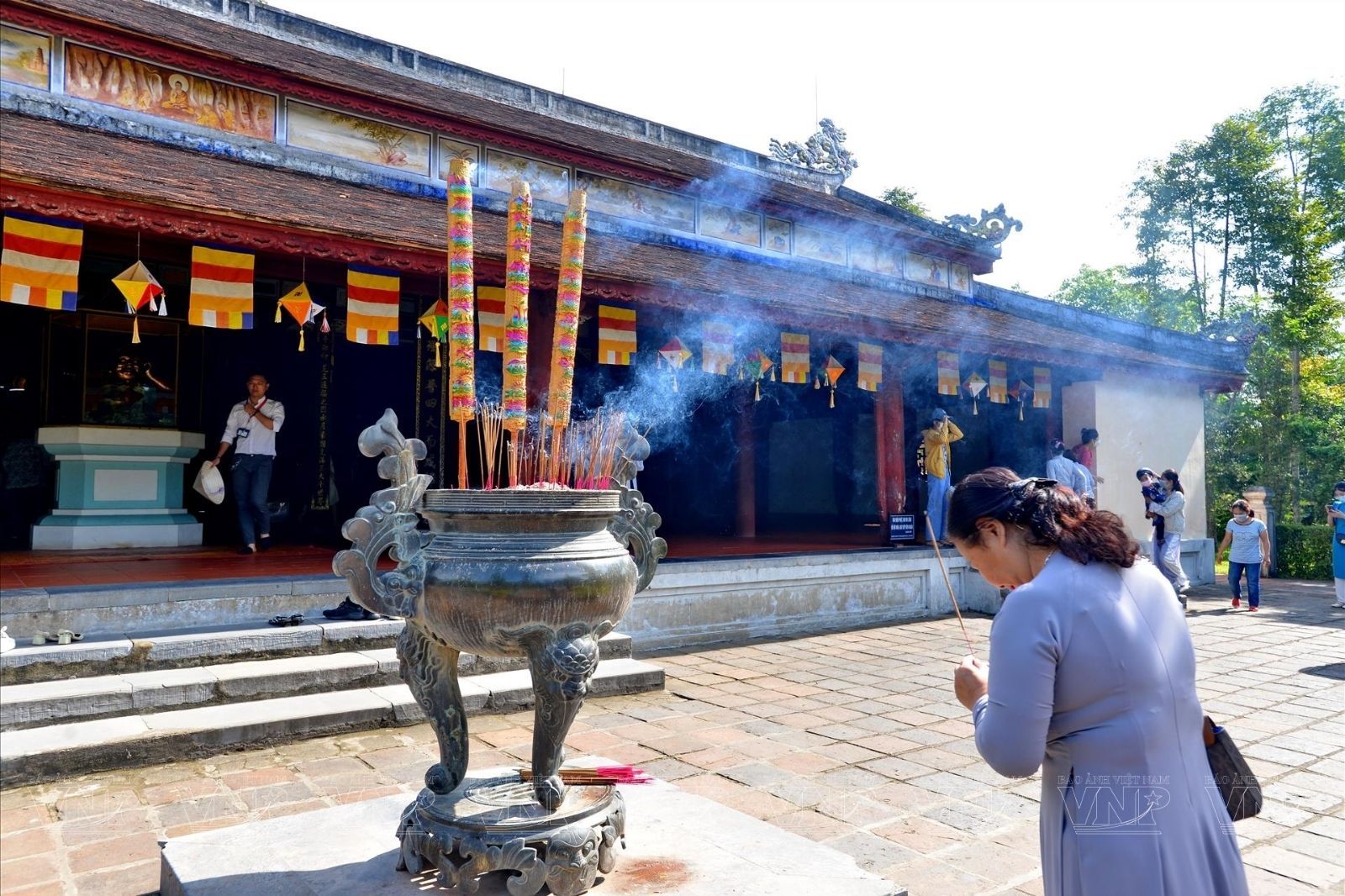
Photo: People making a pilgrimage at Thien Mu Pagoda
Thien Mu Pagoda is not only a symbol of ancient architecture in the heart of Hue, but also a place preserving captivating cultural, historical values, and legends. Visiting this over 400-year-old pagoda, tourists can not only admire the majestic beauty beside the Perfume River but also feel the rhythm of life and the spiritual depth of the ancient capital. For a more fulfilling journey, Sovaba Travel offers a Thien Mu Pagoda tour with a local guide, helping you discover every story, every unique architectural detail, and enjoy the cultural tapestry of Hue in the most profound way. This will surely be a memorable experience, bringing you closer to the soul of poetic Hue.