Why Is Hue Known as the Festival City? A Premier Cultural Destination in Vietnam

Central

Thua Thien Hue

Sovaba.travel

Updated at: 07/10/2026

1. Where Did the Hue Festival Begin?

The history of the Hue Festival began with Vietnam–France cultural exchanges in the early 1990s. In 1992, Hue partnered with the Association of Friends of Hue (Amical des Amis de Hué) and the CODEV organization under Electricité de France (EDF) to organize the "Franco-Vietnamese Cultural Encounter" (Rencontre Franco-Vietnamienne). While experimental at the time, the event marked a notable milestone as Hue royal traditional arts were introduced in a cultural program with international partners.

In 1998, Hue continued organizing another festival edition with French support. This was an essential preparatory step leading to the official birth of the Hue Festival. In October 1998, the Vietnamese Government permitted Thua Thien Hue Province to collaborate with the French Embassy to organize the Hue Festival 2000, establishing a national-scale cultural festival model oriented toward international exchange.

The first Hue Festival took place from April 8 to 19, 2000, under the theme "Hue – City of the Art of Living." It welcomed more than 410,000 attendees, including approximately 41,000 tourists and 6,000 international visitors, featuring over 30 Vietnamese and French art troupes with more than 1,000 participating artists. This scale demonstrated that Hue was fully capable of bringing heritage and traditional arts beyond the boundaries of the ancient capital to become part of contemporary cultural life. Since 2000, the Hue Festival has been held biennially in even-numbered years, progressively expanding in scope and content. Over numerous editions, the festival has evolved beyond a single cultural event into an acclaimed brand synonymous with Hue, bringing together artists and cultural ensembles from around the world.

Lễ hội văn hóa đặc trưng của

Photo: Signature cultural festivals of the "Festival City"

2. Why Was Hue Chosen to Become Vietnam's Festival City?

Hue possesses a rare advantage that few urban centers in Vietnam can claim: heritage is woven directly into the fabric of daily life. Having served as the capital of the Nguyen Dynasty, Hue retains an extensive cultural legacy, from the Complex of Hue Monuments and royal court music (Nha Nhac) to the Nguyen Dynasty Woodblocks, Imperial Records (Chau Ban), Royal Architecture Poetry, and numerous other UNESCO-inscribed treasures. Alongside these are networks of communal houses, pagodas, garden houses, craft villages, traditional festivals, and folk performing arts lovingly preserved across generations.

Yet having heritage alone is not enough to create a Festival City. More importantly, Hue has demonstrated the ability to weave these heritage values into contemporary cultural life, transforming the spaces of the ancient capital into vibrant venues for artistic programs, festivals, and international exchanges.

Sự kiện được triển khai định kỳ, đi từ ý tưởng đến thương hiệu đặc trưng

Photo: Periodically organized events, evolving from concept to signature brand

This vision was formalized in 2007 when the Prime Minister issued Decision 143/2007/QD-TTg approving the Scheme to Develop Hue into Vietnam's Festival City. The master plan set the objective of establishing Hue as a national and international-caliber Festival City, harmonizing cultural preservation with tourism and socio-economic development. In practice, the early festival editions from 2000 onward showed that this pathway was well-founded. The organizing scale expanded continuously, participation from international performance groups grew increasingly diverse, and traditional Hue cultural values retained their central position. Consequently, "Hue – Vietnam's Festival City" has progressively established itself as an enduring hallmark of the ancient capital.

In other words, Hue was chosen not merely because of its wealth of heritage, but because the city possessed the complete foundation required to transform that heritage into a living, breathing cultural reality. This is precisely what distinguishes Hue from destinations that are renowned solely for historical relics.

3. The "Four Seasons Festival" Model

Beginning in 2022, Hue transitioned to the Four Seasons Festival model, replacing the traditional biennial festival format. This innovation broadened the spatial and temporal scope of celebrations, leveraging an ecosystem of over 500 traditional festivals while introducing cultural and tourism offerings throughout the year.

  • Spring – "Ancient Capital Spring": Tied to the festive atmosphere of the Lunar New Year, royal rituals such as the Ban Soc Ceremony (Royal Calendar Distribution), folk cultural activities, and events like the Ancient Capital Martial Arts Festival.

  • Summer – "Shining Citadel": The peak season featuring the International Art Festival Week in even-numbered years or the Traditional Craft Festival in odd-numbered years, complemented by ao dai showcases and street art performances.

  • Autumn – "Hue in Autumn": Distinguished by Mid-Autumn festivities, an international lantern festival, lion-dragon-monk street performances, and lantern parades through city thoroughfares.

  • Winter – "Hue Winter": Centered on musical concerts, indoor cultural exhibitions, and year-end celebrations, culminating in a lively New Year Countdown.

The Four Seasons Festival does not merely extend the calendar of festivities. Its key innovation lies in distributing cultural activities across all seasons rather than confining them to a few peak weeks, thereby encouraging deeper community involvement. Local residents act both as organizers and cultural stewards while directly benefiting from festival tourism. With event schedules announced well in advance, travelers and travel agencies can conveniently customize itineraries. As a result, the festival has shifted from a periodic spectacle into an integral component of Hue's year-round cultural lifestyle.

Chương trình nghệ thuật hấp dẫn mỗi mùa Festival về

Photo: Captivating artistic performances during each festival season

4. Cultural Values That Define Hue as a Festival City

The appeal of the Hue Festival lies not simply in event scale, but in the organic integration of cultural values into everyday life. Royal heritage, folk festivities, traditional crafts, and contemporary arts coexist seamlessly within the distinctive setting of the ancient capital.

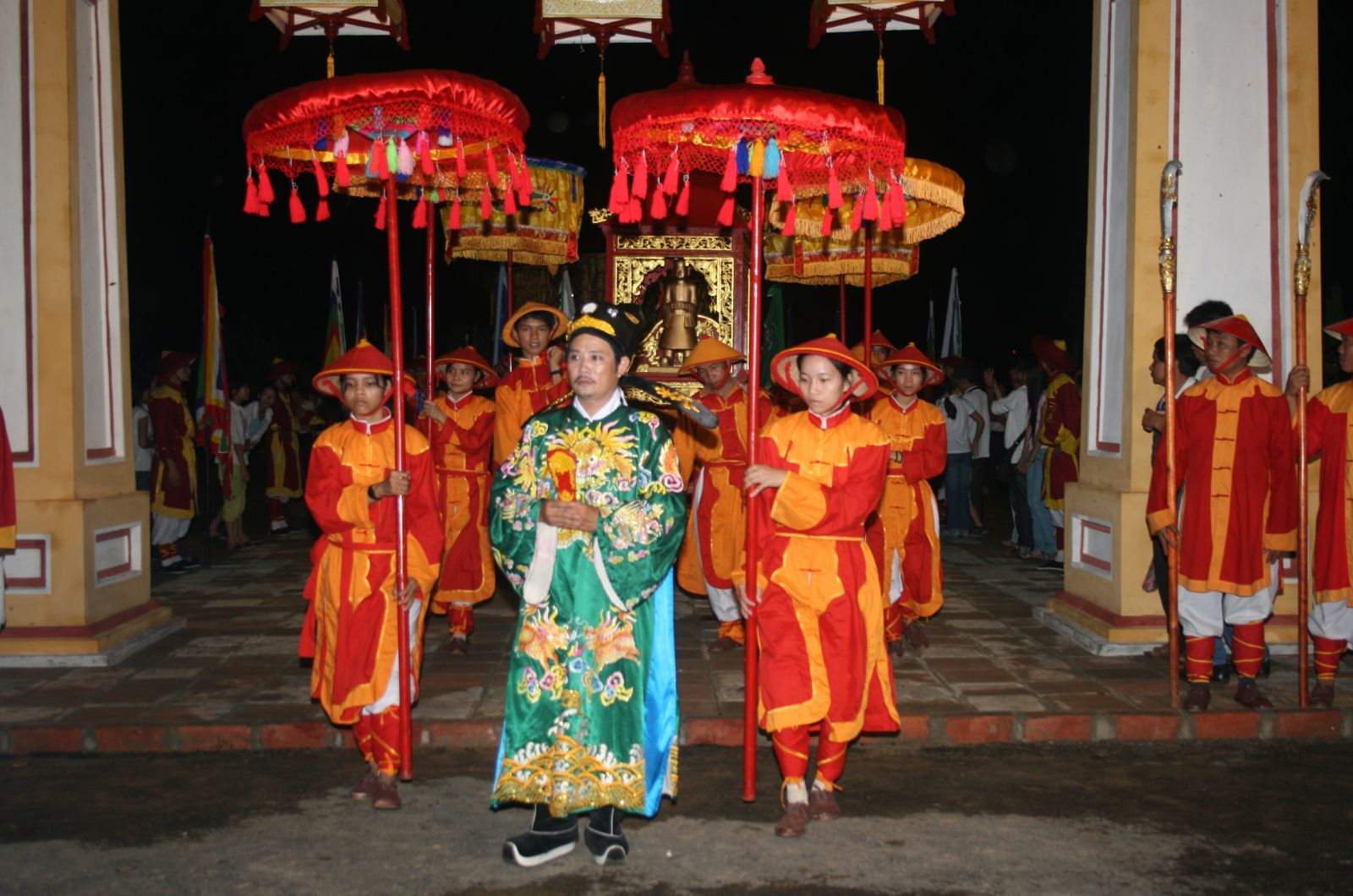
  • Royal Heritage and Traditional Arts: Ceremonies such as the Ban Soc Ceremony, the Nam Giao Offering Rite, Royal Palace Night, and doctoral graduation processions, alongside royal court music, court dances, ao dai, and conical hats, vividly recreate the cultural grandeur of the Hue court. These foundational elements forged the spirit of "Hue – City of the Art of Living" in the earliest festival editions.

  • Folk Festivals and Community Life: The festival extends far beyond the Imperial City and royal monument grounds. Rural village festival markets, kite-flying gatherings, traditional boat races, and ancient craft villages such as Phuoc Tich and Thanh Toan, alongside royal and folk culinary arts, bring festivities closer to community life.

  • International Cultural Exchanges: Domestic and overseas performing troupes unite to create an inspiring space for multicultural dialogue. Hue's heritage is shared with international audiences, while contemporary artistic innovations find a welcoming stage in the imperial city. This mutual exchange flourishes on mutual respect for unique cultural identities without eroding historic traditions.

  • Conservation Linked to Living Practice and Sustainable Development: The festival creates opportunities for heritage restoration, exhibition, and ongoing practice. When residents, artisans, performers, businesses, and tourists participate collectively, preservation is no longer confined to static monuments or archives, but emerges as a dynamic force generating meaningful socio-economic value.

Tái hiện các giá trị văn hóa cung đình

Photo: Reenacting royal court cultural values 

Through these notable achievements, the Hue Festival has firmly established itself as a premier cultural and artistic event on both national and international stages. It contributes not only to preserving and promoting the cultural legacy of Hue and Vietnam, but also creates employment and generates tangible material and spiritual prosperity for local people. For these reasons, the title "Festival City" is entirely deserved, affirming Hue's status as an exceptional hub of traditional culture in the nation.

Loading......

Featured destinations