History of Thien Lam Pagoda Hue: The journey of establishment and portrait of Most Venerable Ho Nhan

Central

Thua Thien Hue

Thien Lam Pagoda

Sovaba.travel

Updated at: 02/10/2026

1. History of Thien Lam Pagoda in Hue

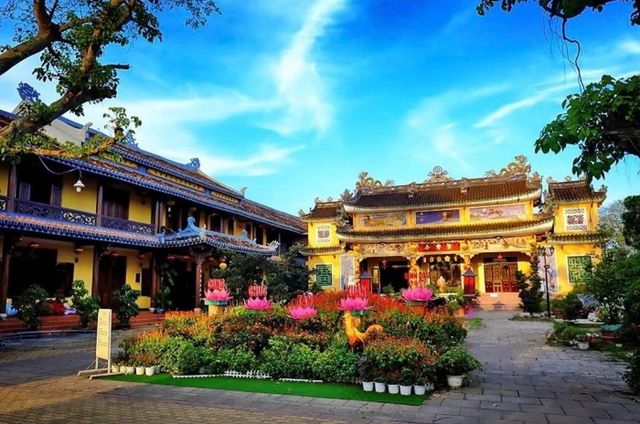
Thien Lam Pagoda in Hue was founded by Most Venerable Ho Nhan in 1960. Initially, the pagoda was just a small thatched hermitage located on Quang Te Hill – a rather wild area, locally known affectionately as "Coc Pagoda" (Hermitage Pagoda). By 1966, thanks to the devotion of numerous Buddhists, the pagoda was built more spaciously with a main hall and a Buddha Relic stupa about 15 meters high, inspired by the architecture of Sirimangalā Pagoda (Myanmar) – where Most Venerable Ho Nhan used to study. In subsequent years, the pagoda continued to expand with a rear hall, sangha quarters, and many other structures, creating its grand appearance today.

The prominent highlights of Thien Lam Pagoda are the Standing Buddha Statue, Reclining Buddha Statue, and Meditating Buddha Statue set amidst lush green spaces. These very structures have earned the pagoda its familiar popular name, "Standing and Reclining Buddha Pagoda". Over more than half a century, Thien Lam Pagoda has not only been a center of practice for the Theravada Buddhist tradition, but also a unique spiritual, architectural, and cultural destination of the ancient capital Hue.

The pagoda known as

Photo: The pagoda known as "Miniature Thailand" in the ancient capital

2. The Buddhist context in Hue during the founding of Thien Lam Pagoda

In the mid-20th century, Hue was still considered the center of Mahayana Buddhism with many ancient ancestral temples and long-standing traditions of practice. Meanwhile, Theravada Buddhism was just beginning to develop in the Central region through eminent monks who had studied in Myanmar, Thailand, and Cambodia, bringing with them the spirit of preserving the original teachings of the Buddha.

In that flow, Most Venerable Ho Nhan was one of the pioneers bringing Theravada Buddhism to Hue. Instead of choosing crowded pagodas for Dharma propagation, he decided to build a small hermitage amidst a deserted hilly area, living a life of solitude, alms-seeking, and meditation. That was not merely a choice of place for practice, but also an expression of the aspiration to return to the simple, pure lifestyle and original spirit of Buddhism. From a simple thatched hut amid a pine forest, Thien Lam Pagoda gradually took shape and developed, becoming a symbol of Theravada Buddhism in the ancient capital of Hue. Today, the pagoda is not only a place of practice, but also a sanctuary where everyone can find peace and listen to themselves amidst the pace of modern life.

Wax statue of Most Venerable Ho Nhan

Photo: Wax statue of Most Venerable Ho Nhan

3. Who founded Thien Lam Pagoda in Hue?

The late Most Venerable Patriarch Ho Nhan was the founder and also the first abbot of Thien Lam Pagoda in Hue. From the early days of building a small thatched hermitage on Quang Te Hill, he devoted all his heart to constructing and developing the pagoda into a representative Theravada Buddhist practice center in Central Vietnam.

Not only creating a unique spiritual monument, Most Venerable Ho Nhan also laid the foundation for the dhutanga lifestyle, alms-round, and meditation according to the Theravada tradition, contributing to preserving and spreading the core values of original Buddhism. After he passed away in 2002, the management and maintenance of the pagoda's activities were entrusted to Venerable Ho Tinh, his disciple, to continue inheriting and promoting the values that the Most Venerable had dedicated his life to building.

Wax statue of Most Venerable Ho Nhan

Photo: Wax statue of Most Venerable Ho Nhan

4. The establishment and development of Thien Lam Pagoda through different periods

The journey of establishing Thien Lam Pagoda in Hue began in 1958, when Most Venerable Ho Nhan set up a small leaf hut in the forest for meditation practice. At that time, the pagoda was just a secluded place with a simple lifestyle of practicing dhutanga alms-taking. By 1960, the pagoda was officially established under the name Thien Lam, belonging to the Theravada sect.

The year 1966 marked a major development step when Buddhists donated to build the main hall and characteristic Buddha statues. Through the 1970s and 1980s, the pagoda continued to expand, becoming a venue for hosting meditation retreats and Buddhist festivals. In 2014, the pagoda underwent a comprehensive renovation, adding modern facilities while retaining its vibrant Theravada architectural style, featuring a peaceful stupa and meditation garden. Today, Thien Lam Pagoda is not only a historical site but also a spiritual tourism destination, attracting thousands of visitors each year.

One of the Buddha statues located at Thien Lam Pagoda
Photo: One of the Buddha statues located at Thien Lam Pagoda 

5. Thien Lam Pagoda in the flow of Buddhism in Central Vietnam

In the Buddhist movement of Central Vietnam, Thien Lam Pagoda in Hue plays an important role as a center of Theravada Buddhism in a region predominantly following Mahayana. Hue has traditionally been the cradle of Vietnamese Buddhism with ancient temples such as Thien Mu or Tu Dam, but Thien Lam Pagoda brought diversity by emphasizing meditation and original doctrines. The pagoda contributed to connecting Hue Buddhism with international traditions, especially through retreats and exchanges with sanghas from Thailand and India.

Thien Lam Pagoda is also a place for organizing charitable activities and Buddhist education, supporting the sustainable development of Central Vietnam's Buddhism. With its location near the center of Hue, the pagoda has become a bridge between tradition and modernity, contributing to the preservation of Central Vietnam's Buddhist cultural heritage.

Statue of Shakyamuni Buddha meditating under the protection of the Serpent King

Photo: Statue of Shakyamuni Buddha meditating under the protection of the Serpent King

The history of Thien Lam Pagoda is not only a story about the creation of a unique architectural structure, but also a dedicated journey of Dharma propagation by Most Venerable Ho Nhan. From a small hermitage on Quang Te Hill, he sowed the Bodhi seeds, creating a place of practice and worship imbued with Theravada Buddhist identity right in the heart of the ancient capital.

If you wish to visit Thien Lam Pagoda in person and listen to the historical stories associated with each roof and Buddhist trace, choosing an all-inclusive Thien Lam Pagoda tour with Sovaba Travel is an ideal recommendation. The tour programs are thoughtfully designed, combining sightseeing, experiences, and historical narration, helping visitors not only "go to see" but also "go to understand" the culture and spirituality of Hue. This is also an opportunity to connect Thien Lam Pagoda with other iconic Buddhist destinations on your journey to explore the ancient capital.

Featured destinations