Quan Chao Temple: An Ancient Relic and Historical Story in Ninh Binh

Northern

Ninh Binh

Sovaba.travel

Updated at: 02/10/2026

1. Overview of Quan Chao Temple and the meaning behind its unique name

Quan Chao Temple is located in Tay Son Ward, Tam Diep City, Ninh Binh Province, about 15km from the center of Ninh Binh City.

Ancient tale about Quan Chao Temple
Photo: Ancient tale about Quan Chao Temple

The Tale of “Quan Chao”

Many visitors are curious about the simple name "Quan Chao" (Porridge Stall), which lacks the solemn air of a sacred site. In fact, this name originates from a real historical story:

In ancient times, Holy Mother Lieu Hanh (one of the Four Immortals) manifested as a roadside tea stall owner to watch over the lives of the people. In 1788, when Emperor Quang Trung (Nguyen Hue) marched swiftly north to drive out 290,000 Qing troops, she personally cooked porridge to treat the entire Tay Son army in the Tam Diep – Bim Son area. The bowl of porridge was not merely food, but also a boost of strength, wisdom, and courage, contributing to the glorious victory at Ngoc Hoi – Dong Da in 1789.

After returning in glorious victory, to express gratitude for the merit of the fairy who offered the porridge, King Quang Trung issued a decree to build a temple right at the site of the former porridge stall and humbly named it Quan Chao Temple.

The temple also has the Sino-Vietnamese name Chuc Son Tien Tu (Fairy Temple of Chao Mountain), dedicated to Princess Lieu Hanh, who aided the insurgent army.

Location and How to Get There

Quan Chao Temple belongs to the Dau Temple – Quan Chao Temple historical relic complex, located along National Highway 1A (southbound) heading towards Tam Diep.

  • Location: Quang Trung, Tay Son, Tam Diep, Ninh Binh.
  • Transportation: From the center of Ninh Binh City, simply head straight south along National Highway 1A to reach the destination. You can travel by motorbike or car (the temple has a spacious parking lot).

Quan Chao Temple, preserving the historical story of Holy Mother Lieu Hanh's troop-rewarding bowl of porridge, is a meaningful spiritual destination easily accessible right on National Highway 1A in Tam Diep City, Ninh Binh.

2. Explore the ancient architecture and sacred worship space

Quan Chao Temple was originally just a small roadside shrine. In the 7th year of Tu Duc's reign (1854), the temple was restored thanks to donations from the Governor of Ninh Binh, Ton That Tinh, preserving its architectural style to this day.

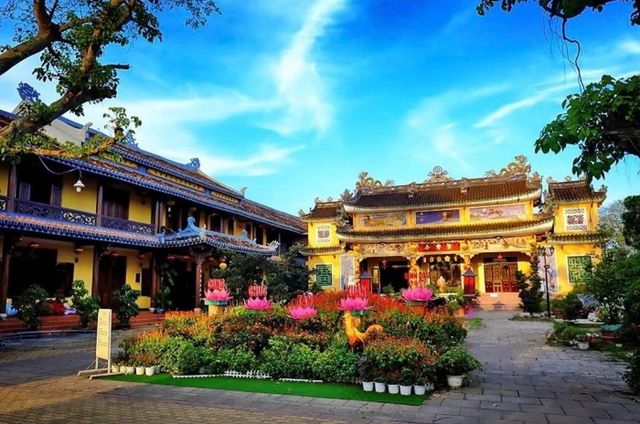
Outside the temple grounds
Photo: Outside the temple grounds

Exterior Architecture and Landscape

  • Overall: The temple is surrounded by decorative walls, with a miniature landscape of Ngu Hanh Son (Marble Mountains) in the front yard.
  • Landscape: The temple yard is shaded by three large ancient trees, offering a sense of relaxation and peace for visitors.
  • Roof: Built in the shape of the Chinese character "Nhi" (二) with a unique mallet-shaped sanctuary. The front roof features two dragons flanking the moon and four raised Chinese characters "Chuc Sơn Tiên Tu".
  • Precious Stone Stele: In the front yard stands a stone stele measuring 1m high and 0.7m wide, recording the restoration event in the 7th year of Tu Duc (1854) commissioned by Governor Ton That Tinh.

Sacred Shrine System

Inside Quan Chao Temple, it is divided into three main worship shrines with a solemnly arranged altar system including:

  • Third Shrine (Cung De Tam): The first shrine, housing the altar of the Council of the Four Palaces, worshiping gods of the Four Palaces system.
  • Second Shrine (Cung De Nhi): Houses the statue of the Temple Goddess (Chua Ban Den). This shrine is highlighted by four monolithic blue stone pillars intricately carved with dragons and phoenixes. On either side of the Temple Goddess are the altars of Quan Hoang Bay (on the right) and Quan Hoang Muoi (on the left).
  • Forbidden Shrine (Cung Cam / Central Sanctuary): This is the most solemn location, worshiping Holy Mother Lieu Hanh. The Mother's statue is placed in a magnificent red-lacquered and gilded shrine. This precious wooden statue was carved during the Nguyen Dynasty, depicting the Holy Mother in a sitting meditation posture. Her face is carved with simple, benevolent features, evoking the image of a kindly grandmother cooking porridge to feed the troops.
  • Left of the Forbidden Shrine: The altar of the Two Attendant Mistresses (Nhi vi Chau Ba).

Today, Quan Chao Temple, restored in 1854, stands out with its "Nhi" character architecture, tree-shaded courtyard, historical stone stele, and a system of three solemn shrines, especially the Forbidden Shrine worshiping Holy Mother Lieu Hanh in a meditative pose.

3 ancient trees in the temple yard
Photo: 3 ancient trees in the temple yard

3. Unique highlights of the traditional festival

The Quan Chao Temple Festival is linked with the Dau Temple Festival in a specific order:

“Chewing betel nut, remember the dried betel piece

Pay homage at Quan Chao Fairy Temple first before presenting to Lady Dau.”

  • Time: The festival officially opens on the 15th day of the 1st lunar month and lasts until the end of the 3rd day of the 3rd lunar month (the death anniversary of Mother Lieu).
  • Important Rituals: According to custom, locals and visitors must pay homage at Quan Chao Temple first, perform ceremonial rites, and then carry the palanquin and statue of the Holy Mother to Dau Temple.
  • Spiritual Activities: The festival is an occasion for solemn and unique worship rituals such as spirit mediumship, incense bowl consecration, and initiation rites to pray for blessings, fortune, longevity, peace, and prosperity from the Holy Mother and deities.

The Quan Chao Temple – Dau Temple Festival lasts from the full moon of the 1st lunar month to the end of the 3rd day of the 3rd lunar month. It is an important spiritual ritual starting with presentations at Quan Chao Temple before carrying the Mother's statue to Dau Temple, where people pray for peace and good fortune.

Quan Chao Temple is not only an ancient relic imbued with the mark of time from the Tu Duc era, but also a living historical page of compassion and national spirit. From the story of Holy Mother Lieu Hanh's bowl of loving porridge sustaining Emperor Quang Trung's great army to the majestic architecture of "Chuc Son Tien Tu" under ancient tree shade, Quan Chao Temple encapsulates spiritual beauty and legendary lore. Together with the Dau Temple Festival, this site creates a religious cultural stream continuing from the full moon of the 1st lunar month, inviting visitors from near and far to return to their roots, worship, and pray for peace and blessings from the deities, forever preserving the beauty of the "Fairy of Chao Mountain" in the heart of Tam Diep City.

Featured destinations