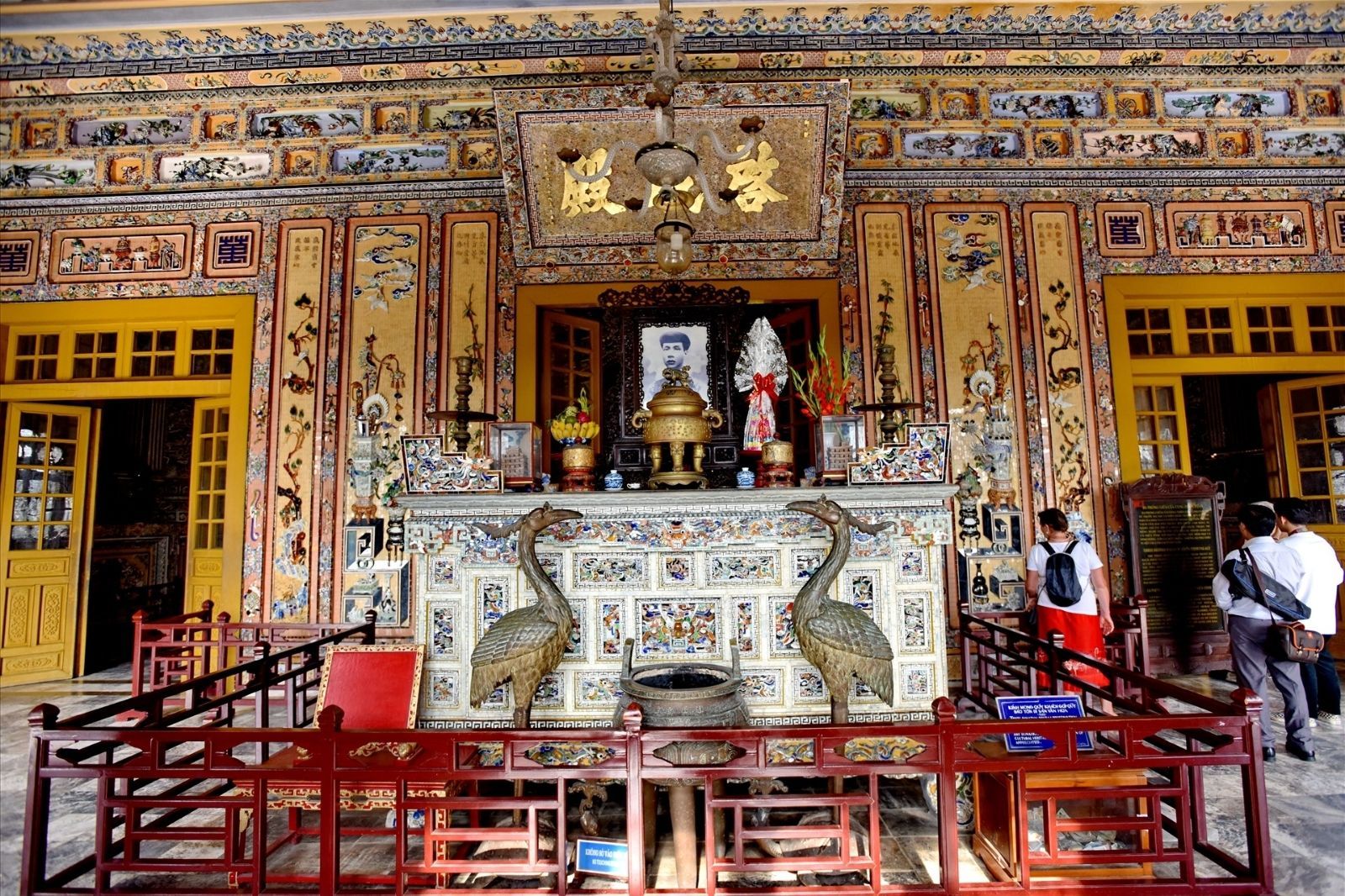
Lăng Khải Định - bản sắc văn hóa Việt Nam.
TRAVEL GUIDEKhai Dinh Tomb

Exploring Khai Dinh Tomb in Hue on your own is an ideal journey for those who love the fusion of Asian-European architectural art and the majestic beauty of the Nguyen Dynasty. From the steps leading up to Chau Chu Mountain, the massive Tam Quan Gate, to the splendid Khai Thanh Palace with its exquisite porcelain mosaic art, a visit to Khai Dinh Tomb will offer you a unique experience, both solemn and overwhelmed by the ultimate sophistication of Hue's royal architecture.

In this handbook by Sovaba Travel, you will find detailed guides to explore the entire tomb, from transportation, the ideal time to visit, to outstanding stops within the architectural complex. In addition, we also share useful tips and visiting costs to make your self-guided trip more complete and memorable.
Brief Overview of the Creation of Khai Dinh Tomb Masterpiece

Khai Dinh Tomb is the resting place of Emperor Khai Dinh (1885–1925), the 12th emperor of the Nguyen Dynasty who reigned from 1916 to 1925. Known as a "modernist" king, he was deeply influenced by Western culture and personally selected Chau Chu Mountain (now known as Ung Son) as the site for his mausoleum. Construction began on September 4, 1920, lasting for 11 years, and was only completed in 1931, after the emperor's passing.

To build this project, Emperor Khai Dinh raised agricultural land tax by 30% nationwide, a decision that sparked considerable controversy in history. Construction materials were meticulously selected: steel, cement, and roofing tiles imported from France; porcelain and glass brought in from China and Japan. This extravagant investment resulted in a unique mausoleum with strong Western-influenced features that also clearly reflected the transitional context of Vietnam in the early 20th century. Here, visitors encounter a subtle blend of traditional Vietnamese architecture with Romanesque, Gothic, and even Hindu styles.

Khai Dinh Tomb reflects the intersection of Eastern and Western cultures
Photo: Khai Dinh Tomb reflects the intersection of Eastern and Western cultures 

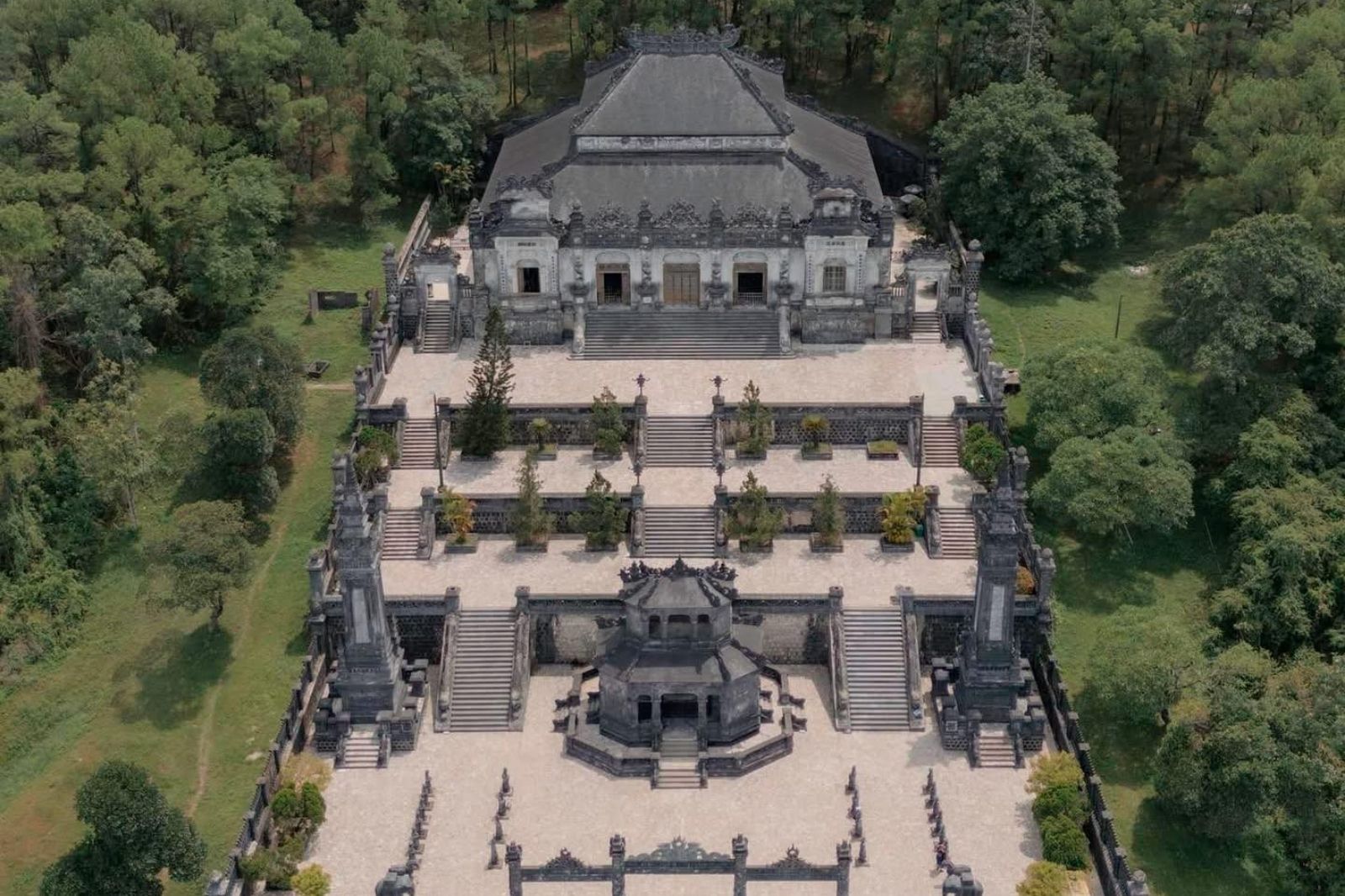
Despite its modest footprint (117m x 48.5m), Khai Dinh Tomb stands out due to its elaborate porcelain mosaic art and intricate carvings in every detail, making it one of the most impressive mausoleums in the ancient capital of Hue. In 1993, this complex was recognized by UNESCO as a World Cultural Heritage site. Remarkably, the emperor's body was interred via a tunnel nearly 30 meters long beneath a bronze statue cast by French artisans in 1920—a living testament to the East-West synthesis in every line.

Location and How to Get to Khai Dinh Tomb

Khai Dinh Tomb is located in Thuy Bang Commune, Huong Thuy Town, Thua Thien Hue Province, about 10 km southwest of central Hue City, on the slopes of Chau Chu Mountain. This location was chosen according to feng shui principles: Chop Vung and Kim Son mountains act as the Left Green Dragon and Right White Tiger, while Chau E stream serves as the converging water element (minh duong).

How to get there:

  • From central Hue: Take Highway 49 (heading south), pass the Minh Mang - Khai Dinh intersection, and continue along Khai Dinh Road for about 5–7 km. Travel time is around 20–30 minutes by motorbike or car.
  • Motorbike: Rent a bike in Hue for 100,000–150,000 VND/day; the road is easy to navigate, with parking available at the tomb entrance.
  • Taxi or Grab: Costs around 150,000–200,000 VND one-way from central Hue.
  • Bus: Bus route No. 3 from Hue to Huong Thuy, though less common for tourists.

Note: The road to the tomb has inclines, so choose appropriate transportation if traveling with the elderly or young children.

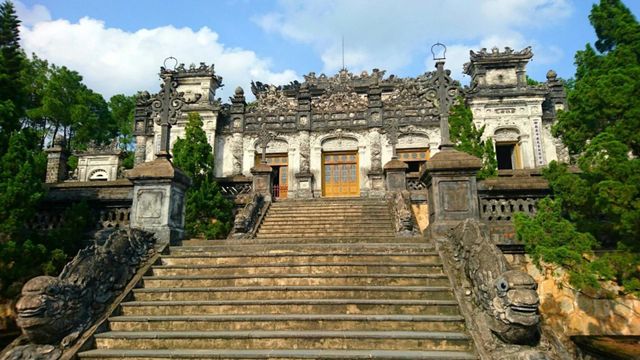
Khai Dinh Tomb is situated on Chau Chu Mountain
Photo: Khai Dinh Tomb is situated on Chau Chu Mountain 

Opening Hours and Ticket Prices for Khai Dinh Tomb

Khai Dinh Tomb is open daily from 7:00 AM to 5:30 PM. Some sources indicate summer hours (March 16 – October 15) are 6:30 AM – 6:00 PM and winter hours (October 16 – March 15) are 7:00 AM – 5:30 PM, but it is recommended to check on-site updates as hours may vary seasonally or during festivals.

Ticket prices (updated 2025):

  • Adults: 150,000 VND/ticket.
  • Children (7–12 years old): 30,000 VND/ticket.
  • Children under 7: Free.

Combo tickets are available for tour routes: 3-site combo (Imperial City - Minh Mang Tomb - Khai Dinh Tomb): 420,000 VND/adult, 80,000 VND/child.

Note: Vietnamese citizens may enjoy free admission on certain major national holidays, such as August 17, 2025 at Hue monuments. Purchase tickets online at eticket.hueworldheritage.org.vn to avoid queueing.

Visitors need to purchase tickets when visiting Khai Dinh Tomb
Photo: Visitors need to purchase tickets when visiting Khai Dinh Tomb 

Highlights of Visiting Khai Dinh Tomb

Visiting Khai Dinh Tomb usually takes 1–2 hours, climbing 127 steps to reach the upper tiers. Here are the must-see spots:

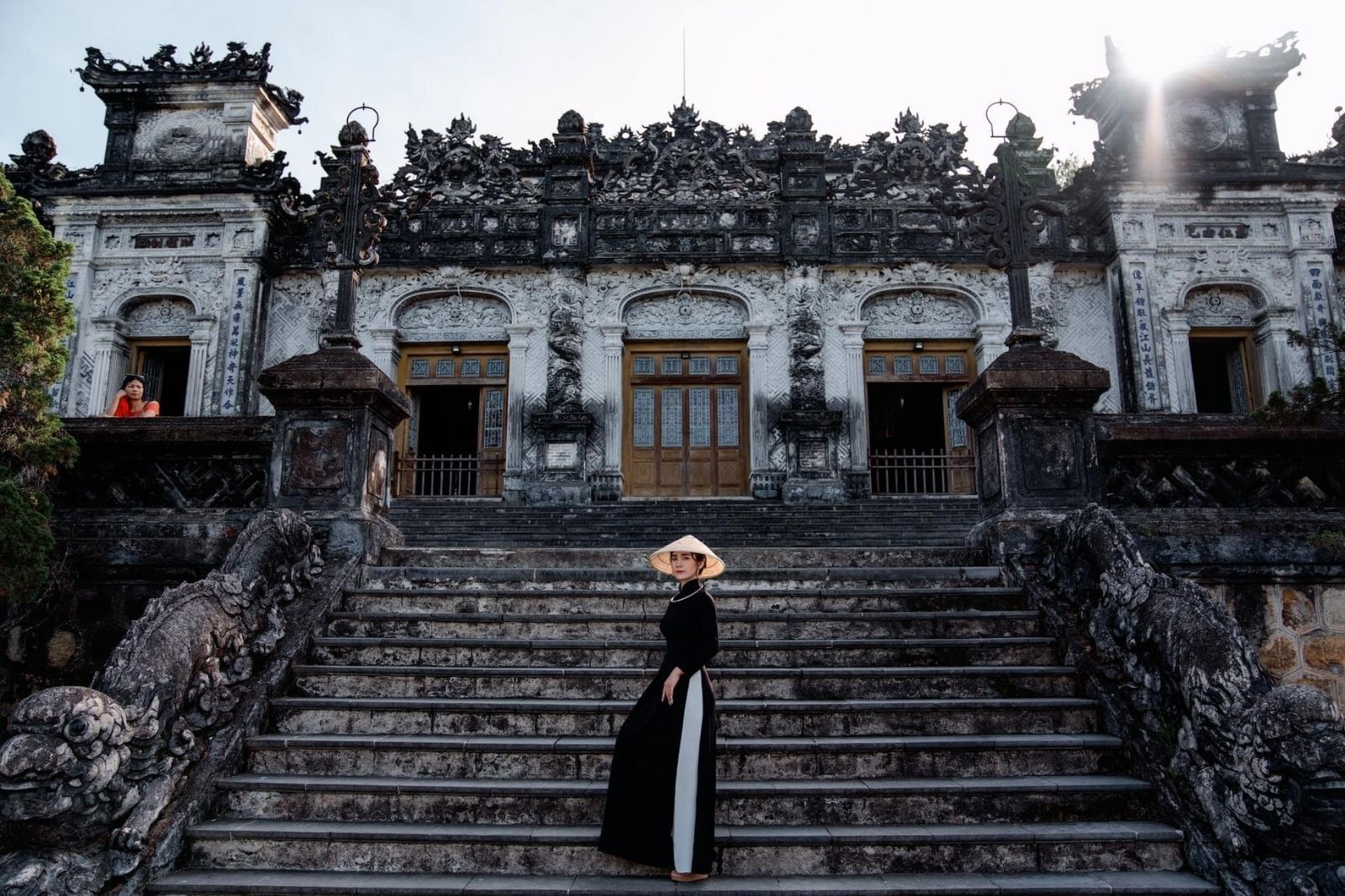
  • Tam Quan Gate (Three-Door Gate): This is the main entrance at the lowest tier, featuring tower-like shapes influenced by Indian architecture, cross-like railings, and Buddhist stupa pillars. It is a favorite check-in spot, offering a mystical vibe and an ideal place to capture panoramic views of the tomb.
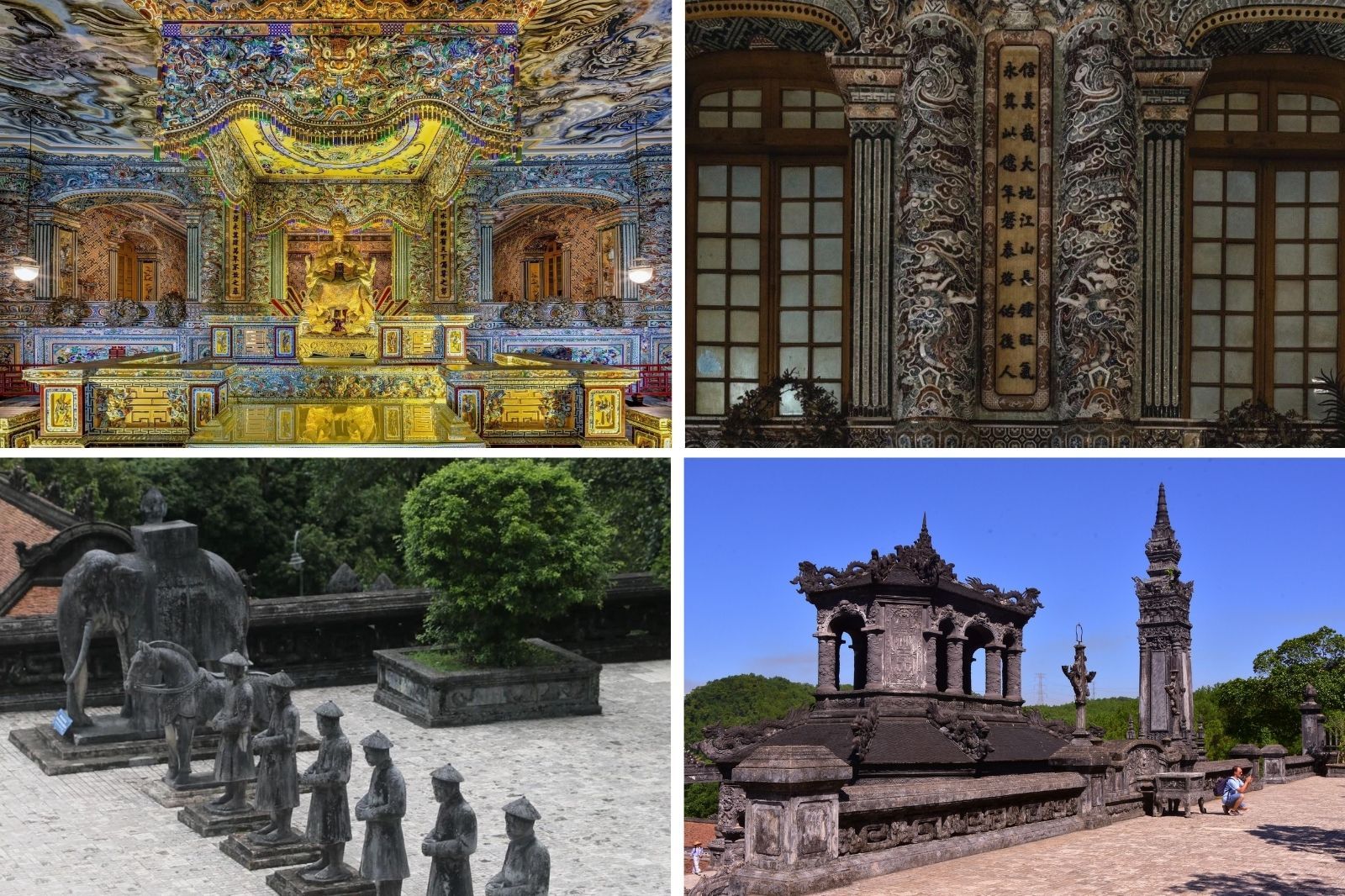
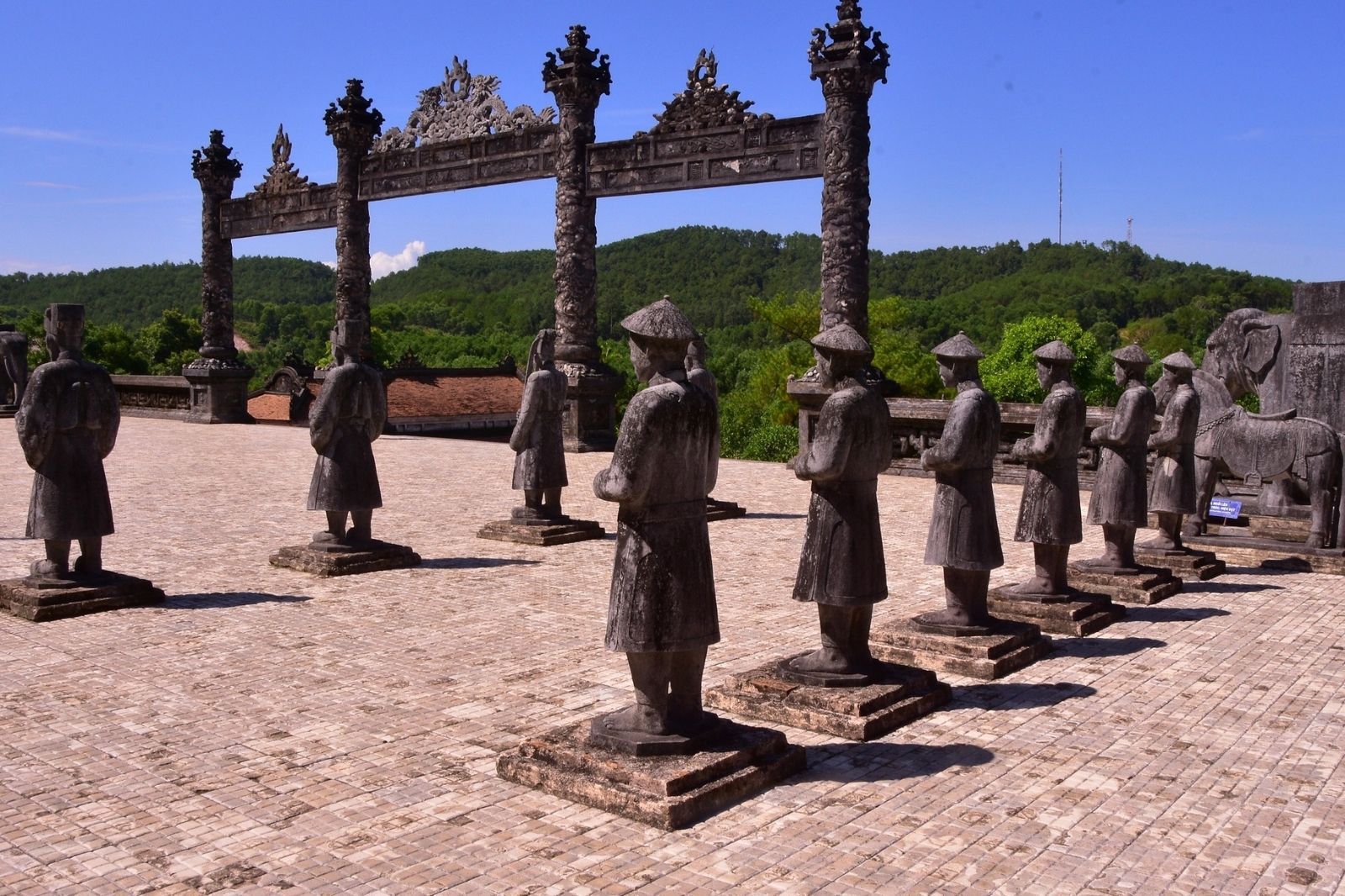
  • Bai Dinh Courtyard and Nghi Mon Gate: Climbing 37 steps leads to the Bai Dinh Honor Courtyard, featuring stone statues of elephants, horses, and civil and military mandarins, along with Nghi Mon Gate—a main gateway reflecting Roman-Gothic architecture. This area exudes majesty with intricate porcelain mosaic details.
  • Thien Dinh Palace: The highest and grandest structure, combining French, Romanesque, and Gothic architecture with Asian influence. Inside are Vietnam's largest ceiling mural "Nine Dragons Hidden in Clouds" painted by artisan Phan Van Tanh, alongside glass and porcelain mosaic relief art. Highlights include a detailed stupa canopy and a setting sun motif symbolizing the king's demise.
  • Khai Thanh Hall: Located inside Thien Dinh Palace, this is where the life-sized bronze statue of Emperor Khai Dinh (cast in France) stands above his burial site under a gilded canopy. Decorated with gorgeous patterns and wall murals, it represents the pinnacle of porcelain mosaic craft.

High-grade materials imported from France, China, and Japan contribute to its uniqueness, forming a rectangular complex surrounded by 3-meter-high walls.

Some structures at Khai Dinh Tomb
Photo: Some structures at Khai Dinh Tomb 

Tips and Notes for Visiting Khai Dinh Tomb

For a smooth trip:

  • Best time to visit: January to September, when weather is pleasant, avoiding winter rains and floods. Visit early in the morning or late afternoon to escape heat and crowds.
  • Attire: Wear polite, modest clothing (long pants, sleeved tops) as this is a spiritual heritage site. Wear comfortable shoes due to many stairs.
  • Preparation: Bring drinking water, sunscreen, and a hat. Hiring a tour guide (around 200,000 VND/group) is recommended for deeper historical insight.
  • Nearby attractions: Combine with visits to nearby Minh Mang Tomb, Tu Duc Tomb (5–10 km away), or Thuy Tien Lake and Thien An Hill.
  • Dining near the tomb: Try Hue clam rice or eat at local eateries in Huong Thuy, priced affordably at around 30,000–50,000 VND/portion.

Note: No flash photography allowed indoors; respect the quiet atmosphere. If traveling independently, use Google Maps for navigation.

Khai Dinh Tomb has become an attractive photo spot for many tourists
Photo: Khai Dinh Tomb has become an attractive photo spot for many tourists

Khai Dinh Tomb is not only a historical monument but also a unique artistic masterpiece, vividly reflecting the East-West cultural blend and Vietnam's transitional mark in the early 20th century. Every step and every delicate porcelain mosaic detail radiates the beauty of a historical era and an emperor with a "modernist" mindset.

To have a complete and meaningful journey exploring Khai Dinh Tomb, you can check out the Khai Dinh Tomb tours organized by Sovaba Travel. With well-planned itineraries, knowledgeable history-culture guides, and professional service, Sovaba Travel will bring you an experience that goes beyond a mere sightseeing trip into a journey discovering the cultural and historical values of the ancient capital.

Articles related to Khai Dinh Tomb